
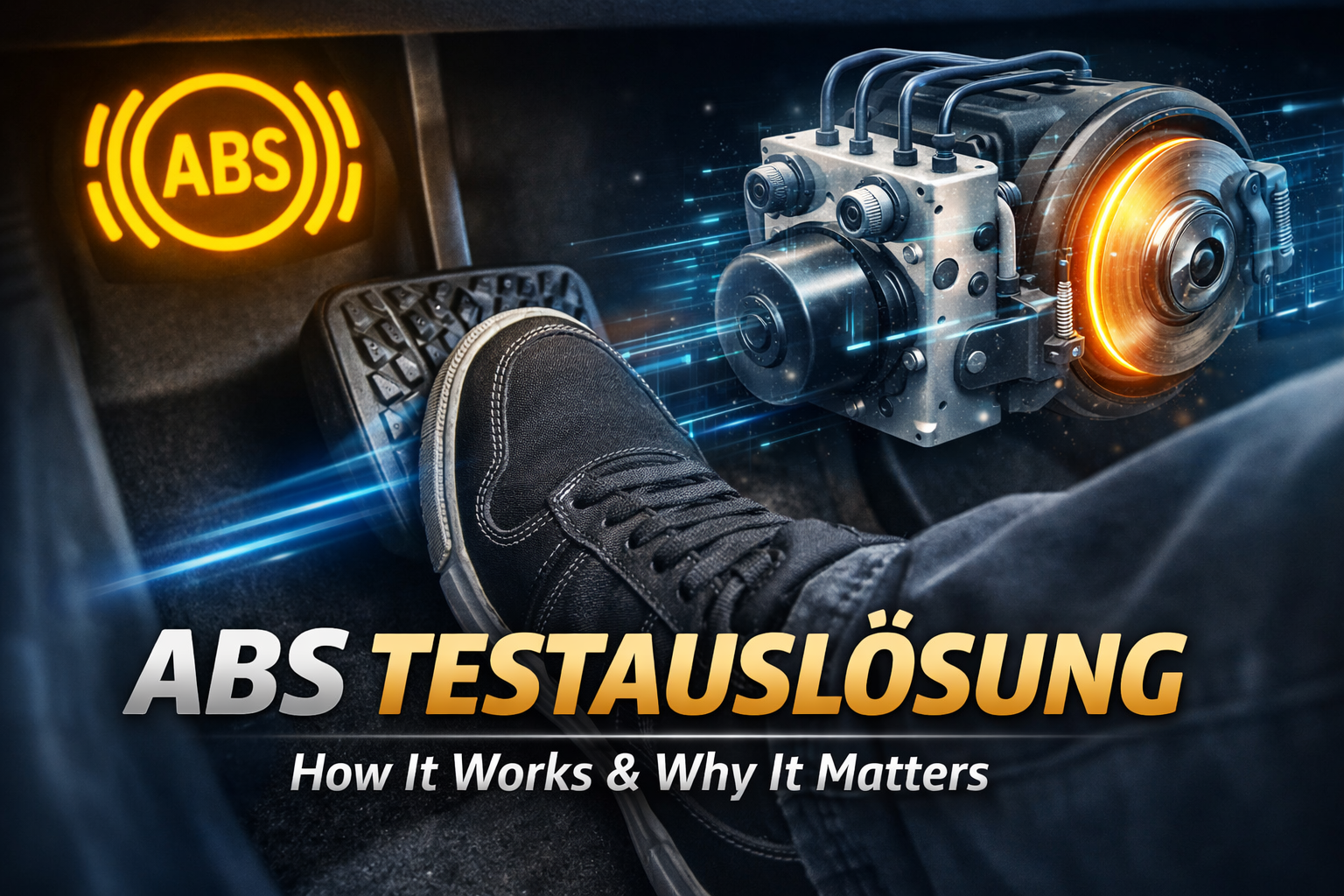
ABS Testauslösung Explained in Detail: Causes, Feel, and Maintenance Tips
Introduction
Imagine starting your car, driving just a few meters, and feeling a slight vibration through the brake pedal, or hearing a faint clicking sound. Many drivers panic, assuming something is wrong. In reality, this is ABS Testauslösung, the self-check of your vehicle’s Anti-lock Braking System (ABS).
Understanding ABS Testauslösung can help you:
- Reduce driving anxiety
- Detect potential issues early
- Avoid unnecessary repairs
- Stay safer on the road
In this article, we’ll explore ABS Testauslösung in depth, with real-life examples, expert insights, troubleshooting advice, and tips for vehicle maintenance.
What Is ABS Testauslösung? A Detailed Look
ABS Testauslösung is a brief automatic self-test performed by the ABS. It occurs when the system briefly activates internal components to ensure everything is working properly.
Components involved in ABS Testauslösung include:
- Wheel speed sensors: Detect the rotational speed of each wheel
- Hydraulic valves: Control brake pressure to prevent wheel lock-up
- ABS control module: Monitors sensor input and coordinates braking response
The test is usually triggered at low speeds, often between 5–20 km/h. Attentive drivers may notice a short pulse in the brake pedal or a soft clicking sound.
This check ensures your ABS is ready to respond in emergencies, such as sudden braking on slippery roads.
The History of ABS and How Testauslösung Became Standard
Anti-lock Braking Systems were first developed in aviation to prevent airplane wheels from locking during landing. By the late 1970s, ABS technology was adapted for automobiles.
Early ABS systems were mechanical and prone to errors. Modern systems, introduced in the 1990s, added electronic self-checks — today known as ABS Testauslösung.
This feature allows vehicles to:
- Automatically verify sensor function
- Check hydraulic control circuits
- Detect early malfunctions before emergencies occur
Why ABS Testauslösung Matters for Safety
ABS prevents wheels from locking during braking, maintaining steering control. Locked wheels increase stopping distances and make maneuvering nearly impossible, especially on:
- Wet or icy roads
- Gravel or uneven surfaces
- Urban traffic situations with sudden stops
By performing a self-test, ABS Testauslösung ensures:
- Systems are fully functional
- Traction control and stability control are operational
- Early detection of faults prevents accidents
Statistical Insight: Vehicles with functioning ABS have up to 35% lower risk of serious collisions during emergency braking compared to vehicles without ABS.
When Does ABS Testauslösung Usually Occur?
ABS Testauslösung is typically triggered:
- Just after starting the vehicle and driving at low speeds
- After engine restart during short stops
- In colder weather, when brake fluid viscosity changes
- Occasionally during minor system calibrations in modern vehicles
Drivers should know that occasional self-tests are completely normal and are not a sign of malfunction.
Normal vs. Abnormal ABS Testauslösung: How to Tell the Difference
Normal Signs:
- Brief, subtle vibration
- Short clicking or humming sound
- No ABS warning light on dashboard
Abnormal Signs:
- Strong or repeated vibrations
- Persistent ABS warning light
- Brake pedal feels inconsistent
- Occurs during normal braking at higher speeds
Tip: If abnormal signs appear, have your car inspected immediately. Early diagnostics prevent costly repairs and improve safety.
Common Causes of ABS Testauslösung
While the self-test is the primary cause, other factors may influence how noticeable it feels:
- Dirt or debris on wheel speed sensors
- Uneven tire wear or incorrect tire size
- Low battery voltage or electrical issues
- Worn brake components or low-quality brake fluid
Maintaining your vehicle ensures smooth ABS operation.
How ABS Testauslösung Feels While Driving: Real-Life Examples
Drivers often describe the sensation as:
- Gentle pulsing in the brake pedal
- Short clicking or humming sound
- Mild vibration, lasting a second or two
Example: On a rainy morning, you lightly press the brakes at low speed and feel a vibration. Later, in an emergency stop, ABS fully engages, preventing wheel lock-up and allowing safe steering.
This demonstrates how ABS Testauslösung prepares the system for real-world conditions.
ABS Testauslösung and Modern Vehicle Technology
ABS self-tests are part of a network of safety systems including:
- Electronic stability control
- Traction control
- Hill-start assist
Manufacturers continuously refine ABS Testauslösung to be quieter and less noticeable, while maintaining reliability. This ensures all integrated systems are synchronized and ready to respond.
Troubleshooting ABS Testauslösung Issues
If ABS Testauslösung feels abnormal, consider these steps:
- Check dashboard lights: Persistent ABS warning signals may indicate sensor or module issues
- Inspect tires: Uneven wear or mismatched sizes affect wheel sensors
- Clean sensors: Dirt and debris can disrupt signals
- Check brake fluid and battery voltage: Low levels can trigger repeated self-tests
Professional inspection is recommended if problems persist.
The Role of ABS Testauslösung in Preventing Accidents
By verifying system readiness before emergencies:
- ABS Testauslösung improves reaction time
- Enhances vehicle stability during sudden braking
- Reduces the likelihood of skidding or collisions
This small self-check is crucial for road safety, especially in urban or adverse driving conditions.
ABS Testauslösung and Vehicle Maintenance: Expert Tips
- Perform regular brake inspections
- Clean wheel speed sensors periodically
- Replace brake fluid as recommended by the manufacturer
- Monitor ABS warning lights and address issues promptly
Proper maintenance prolongs component life and ensures reliable ABS operation.
Differences Between ABS Testauslösung and Full ABS Activation
ABS Testauslösung:
- Occurs at low speed
- Brief pulse in brake pedal
- Tests system functionality
Full ABS Activation:
- Occurs during hard braking
- Strong, prolonged pedal pulsation
- Actively prevents wheel lock-up
Knowing the difference keeps drivers calm and confident.
Future of ABS and Self-Checking Systems
Advances in automotive technology are improving ABS systems:
- AI-driven predictive braking
- Faster, quieter self-checks
- Integration with autonomous emergency braking
- More accurate sensor calibration
Understanding ABS Testauslösung today prepares drivers for future safety innovations.
Frequently Asked Questions About ABS Testauslösung
1. Is ABS Testauslösung harmful to my brakes?
No, it’s a brief hydraulic and electronic check.
2. Why does it feel different in some cars?
Vehicle design, temperature, and road conditions affect how noticeable it is.
3. Should I worry if I hear it occasionally?
No, occasional self-tests are normal.
4. When should I see a mechanic?
If vibrations are strong, frequent, or accompanied by warning lights.
5. Can ABS Testauslösung fail silently?
Rarely, but regular maintenance and inspection reduce the risk.
Conclusion
ABS Testauslösung is a small but critical component of modern vehicle safety. It ensures your ABS and integrated safety systems are operational, boosting driver confidence and preventing accidents.
By understanding, observing, and maintaining your braking system, you stay safer and reduce long-term costs. Remember: what may feel like a minor vibration could be your vehicle actively keeping you protected.




One thought on “ABS Testauslösung Explained in Detail: Causes, Feel, and Maintenance Tips”