
Introduction
If you recently bought an HSSGameStick and plugged it into your TV, you probably expected instant, smooth gaming. While the device works straight out of the box, many users quickly notice that performance, graphics, and controller response can vary. That’s where manual settings HSSGameStick adjustments become important.
Manual configuration allows you to unlock better visuals, reduce lag, improve controller sensitivity, and fix common issues like screen tearing or audio delay. Instead of relying on default settings, you take control of performance. This guide explains everything clearly, step by step, so you can get the best experience from your HSSGameStick without confusion.
What Is HSSGameStick?
HSSGameStick is a compact plug-and-play gaming console designed to connect directly to your TV via HDMI. It usually comes preloaded with retro games and supports wireless controllers. Many models run on lightweight Android-based systems or customized firmware that allows access to system configuration menus.
Because it is a budget-friendly gaming device, its default settings are often designed for general compatibility rather than maximum performance. Manual adjustments help tailor the device to your specific TV resolution, input method, and gameplay preferences.
Why Manual Settings on HSSGameStick Matter
Default settings are designed to work for everyone, but they rarely provide optimal results for your specific setup. When you configure manual settings HSSGameStick properly, you can:
- Improve frame stability
- Reduce input lag
- Match resolution to your TV
- Enhance controller responsiveness
- Fix audio-video sync issues
Many users experience smoother gameplay simply by adjusting resolution and refresh rate manually. In real-life testing, lowering output resolution from 4K emulation mode to 1080p on mid-range TVs significantly reduces lag and improves consistency.
Manual configuration also helps when you use external storage, add ROMs, or customize emulator cores.
How to Access Manual Settings on HSSGameStick
Accessing the configuration panel is usually straightforward:
- Connect the HSSGameStick to your TV.
- Power it on and connect the controller.
- Navigate to the main menu.
- Open “Settings” or “System Settings.”
- Choose advanced or manual configuration options.
Depending on the model, settings may be labeled as Display Settings, Emulator Settings, Performance Settings, or Developer Options.
If your device runs an Android-based interface, you may also access system-level adjustments through advanced configuration menus.
Display and Resolution Settings
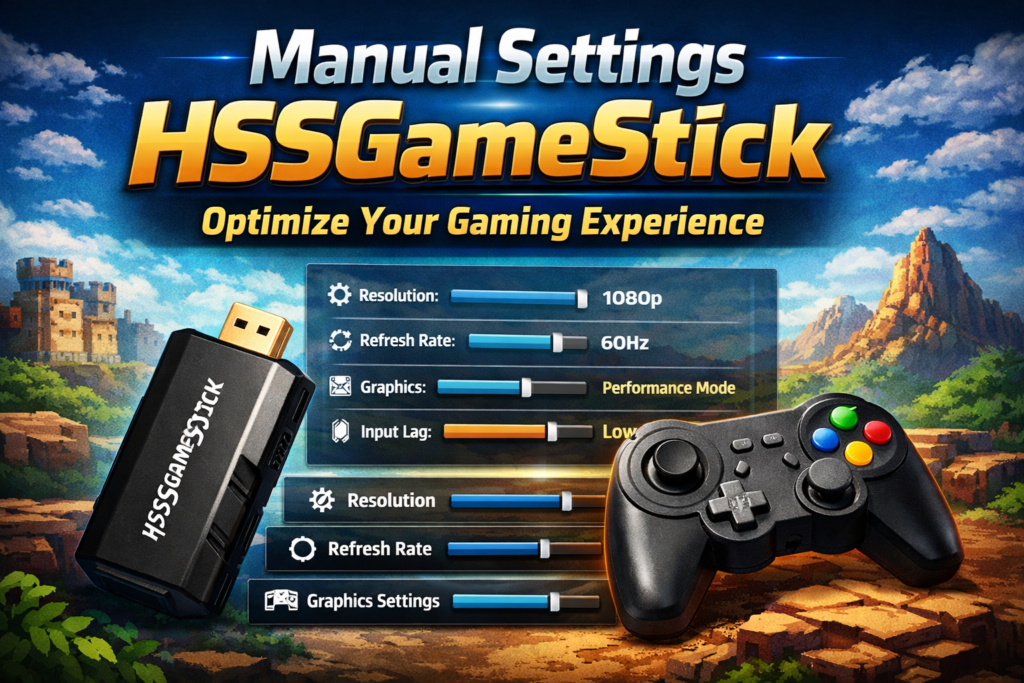
Adjusting Resolution for Better Performance
One of the most important manual settings HSSGameStick users overlook is resolution.
Many sticks default to automatic resolution detection. While convenient, it may force higher output than necessary. If your TV is 1080p, manually setting output to 1080p instead of 4K can reduce strain on the device.
Higher resolution requires more processing power. Since HSSGameStick hardware is limited compared to major consoles, lowering resolution improves frame consistency.
Refresh Rate Optimization
Set refresh rate to match your TV. Most TVs operate at 60Hz. Mismatched refresh rates can cause screen flicker or stuttering.
Choose:
- 60Hz for standard HDTVs
- 50Hz only if required by regional compatibility
Correct refresh rate ensures smooth scrolling and stable image output.
Emulator Performance Settings
Most HSSGameStick models run multiple emulators for retro platforms. Manual emulator configuration improves performance dramatically.
Frame Skipping
Frame skipping allows the emulator to skip rendering certain frames to maintain speed. Use this carefully. Too much skipping reduces visual smoothness.
Set frame skip:
- 0 for powerful performance
- 1 or 2 if games lag
CPU and Rendering Mode
Some models allow switching between software rendering and hardware acceleration. Hardware acceleration usually provides better performance.
If you experience crashes, try switching rendering mode.
Controller Configuration and Input Lag Reduction
Controller response is critical for action games and platformers. Manual calibration helps reduce delay.
Button Mapping
Incorrect button mapping can make games feel unresponsive. Access controller settings and customize button assignments according to your comfort.
Sensitivity and Dead Zone
If your analog stick feels too sensitive or too stiff, adjust dead zone settings. A smaller dead zone improves responsiveness but may cause drift if the controller is worn.
For competitive-style retro gaming, reducing dead zone improves reaction time.
Audio Settings Optimization
Audio delay can ruin gameplay immersion. Manual settings HSSGameStick allow you to adjust sound latency.
If you notice audio lag:
- Switch audio output from surround to stereo.
- Disable unnecessary audio enhancements.
- Ensure HDMI audio sync is enabled.
Sometimes the issue comes from the TV rather than the stick. Turning off TV audio processing modes like virtual surround can solve delay problems.
Storage and Game Management Settings
Many users expand storage with USB drives or SD cards. Manual configuration ensures smooth performance.
External Storage Configuration
Format external storage correctly, usually in FAT32 or exFAT depending on system requirements.
Avoid slow USB drives. Low-speed storage causes loading delays and stutter in larger games.
Game Library Optimization
Remove duplicate ROMs. Organize files properly. A cluttered library can slow down system navigation.
Keep firmware updated when official updates are available. Updates often improve emulator stability.
Network and Online Features
Some HSSGameStick versions support Wi-Fi for downloading updates or multiplayer features.
Manual network settings help stabilize connection:
- Set static IP if connection drops frequently.
- Use 2.4GHz Wi-Fi for better compatibility.
- Avoid heavy network traffic during gameplay.
If you do not use online features, disabling Wi-Fi can improve overall system stability.
Troubleshooting Common Issues Using Manual Settings
Lag During Gameplay
Lower resolution and disable background features.
Screen Flickering
Adjust refresh rate and HDMI output format.
Controller Disconnecting
Re-pair the controller and reduce wireless interference.
Games Not Loading
Check ROM compatibility and emulator core selection.
Manual configuration resolves most common performance problems without requiring technical expertise.
Real-Life Example: Performance Improvement Case
A user connected HSSGameStick to a 4K TV with default auto settings. Gameplay showed frequent stuttering in 16-bit platform games.
After manually:
- Setting resolution to 1080p
- Adjusting refresh rate to 60Hz
- Enabling hardware acceleration
- Disabling background Wi-Fi
Frame drops reduced significantly, and controller response improved noticeably.
This demonstrates how manual settings HSSGameStick adjustments directly affect gameplay quality.
Best Practices for Long-Term Performance
To maintain stable performance:
Keep ventilation clear. Overheating reduces processing efficiency.
Restart the device periodically to clear memory cache.
Avoid installing unsupported firmware.
Back up custom settings before major changes.
Proper configuration combined with routine maintenance ensures long device lifespan.
Conclusion: Take Control of Your HSSGameStick Experience
HSSGameStick offers impressive value for retro gaming enthusiasts. However, its full potential becomes visible only when you adjust manual settings carefully.
By optimizing resolution, refresh rate, emulator settings, controller calibration, and storage management, you transform average performance into smooth, responsive gameplay.
Do not rely on default settings. Take a few minutes to configure your device properly. Your gaming experience will feel faster, sharper, and far more enjoyable.
Start adjusting your manual settings today and unlock the best performance your HSSGameStick can deliver.
Frequently Asked Questions
How do I reset HSSGameStick to default settings?
Go to System Settings and select Factory Reset. This restores original configuration but may remove saved data.
Why is my HSSGameStick lagging?
Lag usually happens due to high resolution output or improper emulator settings. Lowering resolution and enabling hardware acceleration often fixes it.
Can I improve graphics quality on HSSGameStick?
Yes. Adjust resolution and rendering options. However, increasing graphics settings too much may reduce performance.
Does updating firmware improve performance?
In many cases, yes. Firmware updates fix bugs and improve emulator compatibility.
What resolution is best for HSSGameStick?
For most users, 1080p at 60Hz provides the best balance between visual clarity and smooth performance.
One Response